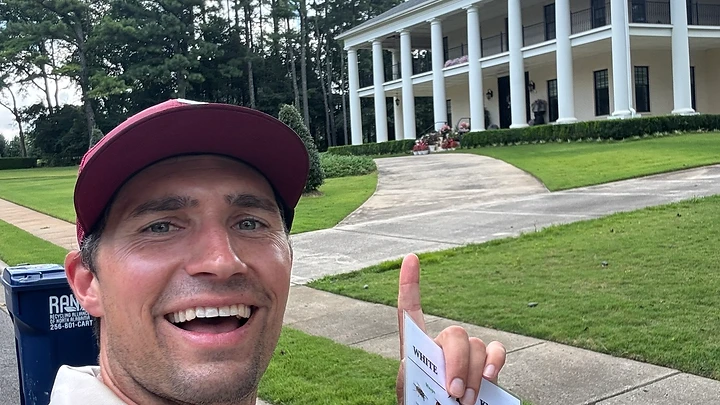
Short answer: there's no salary to quote you. Most door-to-door sales jobs are commission-only, so what you make depends on the industry, the commission per sale, and how many doors you actually knock. A first-summer rep at a solid program usually lands somewhere in the low five figures for the summer. Reps who come back for year two usually make meaningfully more. Top reps make real money — but nobody can promise you those numbers.
I've done this. I've built teams doing this. I've watched hundreds of reps knock their first door. Here's the honest version — no recruiting pitch.
The Honest Math
Forget the salary websites. They'll tell you door-to-door sales pays $70,000 a year, like it's a salaried job. It's not. Your pay is one formula:
Commission per sale × sales per day × days you actually work.
That's it. That's the whole paycheck. Change any one of those three numbers and your income changes with it.
Run it yourself on our earnings calculator — plug in a commission, a realistic number of sales per day, and see what a summer actually looks like. Don't take anyone's word for it, including mine. Do the math.
What Commission Looks Like by Industry
The industry you pick decides your commission per sale more than anything else. Here's the range I use when I'm talking to someone about this:
Pest control: $150–$500 per sale. The classic summer job. Recurring service, so every sale keeps paying you. Lower ticket means it's a volume game.
Solar: $500–$5,000 per sale. Bigger ticket, bigger commission. Longer sales cycle, fewer deals, and you'll hear "let me think about it" a lot more.
Home security: $200–$2,000 per sale. Similar model to pest control — recurring monthly revenue, straightforward pitch, summer programs.
Roofing: $1,000–$7,000 per sale. Storm-driven, big tickets, very seasonal. Feast or famine.
Fiber and internet: $75–$250 per sale. The year-round option. More of these roles offer a base plus commission — steadier pay, lower ceiling.
Other (windows, gutters, pressure washing, etc.): $50–$1,000 per sale. Local companies, smaller tickets, solid entry point.
Same rep, same work ethic, totally different paycheck depending on which of those he's selling. That's why "how much do door-to-door salesmen make" doesn't have one answer. It has six.
First Summer vs Second Year vs Top Reps
First summer. You're learning the skill while you're doing it. Your pitch is rough, you take rejection personally for the first few weeks, and you spend a lot of time figuring out what you're doing. A first-summer rep at a solid program who shows up every day and takes coaching usually lands somewhere in the low five figures for the summer. Some make less. That's the reality, and any company that won't say that out loud is selling you something.
Second year. This is where the jump happens. You come back knowing the pitch, knowing the neighborhoods, knowing how to handle objections. You're not starting from zero anymore. Second-year reps who come back almost always make meaningfully more than they did their first summer, because the skill compounds. Same hours, better close rate, bigger checks.
Top reps. You'll hear big numbers in recruiting pitches. Some of them are real. The guys at the top of a good program make real money — more in a summer than most people make in a year at a desk job. But here's the part the pitch leaves out: those reps knocked more doors than everyone else, took more coaching than everyone else, and stuck around when it got hard. Nobody can promise you their numbers, because your pay is a direct function of your output. If a company guarantees you a specific income on straight commission, walk away. They can't guarantee it.
What Actually Determines Your Pay
Four things, in order:
Doors knocked. This is the big one. The reps who make the most money knock the most doors. It's not complicated. More conversations equals more sales. The guys who go home early don't make top-rep money, and nobody's surprised about it.
Skill. Your close rate gets better every week you stick with it. Objection handling, reading people, knowing when to push and when to walk away — that's a skill, and it compounds.
Industry. A solar deal pays more than a pest control deal. But solar deals are harder to close and take longer. Volume versus ticket size is a real tradeoff, and the right answer depends on you.
Program quality. This one gets overlooked. A good program trains you, gives you a real territory, and pays you what they said they'd pay you. A bad program burns you out, pays late, and blames you for it. The company you pick matters as much as how hard you work.
The Commission-Only Reality
Almost every summer D2D job is commission-only. No hourly. No salary. You eat what you kill.
That means two things you need to be honest with yourself about. First, there will be weeks where you make very little — especially early. If you need guaranteed income to make rent, this isn't the job for that season of your life, and that's fine. Second, the upside is real because there's no cap. Nobody's deciding what you're worth. The market decides, door by door.
Before you sign with any company, ask these questions:
- What's the commission structure, exactly? If they can't explain it in one clear sentence, it'll be worse when the checks come.
- What does training actually look like? "Just go knock" is not training.
- What did average reps make last summer? Averages — not just the top guy's number.
- Where will I live, and who pays for it? Housing costs eat your summer fast if you don't ask first.
- When do I get paid? Some industries pay weeks or months after the sale. Know that before you start, not after.
If they dodge any of those, that's your answer about the company.
I wrote more about what to look for in a D2D job on our door-to-door sales jobs page — industries, hiring, and red flags included.
FAQ
Do door-to-door salesmen make good money?
They can. The ceiling is higher than almost any job you can get at 19 or 20 with no degree. But there's no floor, either — it's commission-only, so your pay tracks your output. Good money is available. Guaranteed money is not.
Is door-to-door sales commission only?
Almost always, for summer programs. Some year-round roles (fiber especially) offer a base salary plus commission. If a company advertises a salary for a summer program, read the fine print — it's usually a draw against future commissions, not extra money.
How much can a first-year rep expect to make?
At a solid program, showing up every day and taking coaching, somewhere in the low five figures for the summer is a realistic expectation. Second-year reps usually make meaningfully more. Anyone promising you a specific number on commission is guessing — or lying.
What industry pays the most in door-to-door sales?
Per sale, roofing and solar pay the most. Per summer, it depends — high-ticket industries mean fewer deals and longer cycles, while pest control and alarms are volume games. The best-paying industry for you is the one you'll actually stick with all summer.
What's Next
Still have questions? Good — you should. Check out what we're hiring for right now, or reach out directly and ask me anything. I'd rather answer your hard questions now than have you learn the answers the expensive way.